Machine learning models - Tree-based
This note contains the code of machine learning models on a specific task - job segmentation. The model can be used to automatic predict which part of the job description, general there are four parts in a typical job description:
- company introduction,
- tasks
- requirements
- benefits
It is a typical classification problem on NLP. And it is super useful in our daily analysis on label market.
The feature engineering have been done, feel free to check the this notebooks and the previous chapters. There are three types of features:
- Bag-of-words features: vectorize each text with tfidf-vectorizer and reduce the feature dimension with SVD down to 50 components.
- Text-based statistical features: e.g. word counts, characters counts, punctuation counts … etc.
- Part of speech features: noun, verb, adj, …
Here I will only focus on machine learning modelling, which will include model training, evaluation, parameter tuning and model comparison.
Load data
df_train = pd.read_csv("train_data.csv", index_col=0)
df_test = pd.read_csv("test_data.csv", index_col=0)

def load_data():
    X_train = df_train.drop("label", axis=1)
    y_train = df_train["label"]

    X_test = df_test.drop("label", axis=1)
    y_test = df_test["label"]
    return X_train, y_train, X_test, y_test

X_train, y_train, X_test, y_test = load_data()

print(X_train.shape, X_test.shape)
(2103, 63) (902, 63)
Model selection
Here I will focus on tree-based models and neural networks.
- Decision Tree
from sklearn import tree
DTC = tree.DecisionTreeClassifier(
    criterion="entropy",
    max_depth=8,
    min_samples_split=10,
    max_features="auto",
    random_state=100
)
DTC.fit(X_train, y_train)
train_score = DTC.score(X_train, y_train)
test_score = DTC.score(X_test, y_test)
print("Training accuracy: {0:5.2f}%.\
      \nTesting accuracy: {1:5.2f}%."
      .format(100*train_score, 100*test_score))
Training accuracy: 93.34%.
Testing accuracy: 86.59%.
- Random Forest
from sklearn.ensemble import RandomForestClassifier
RFC = RandomForestClassifier(
    n_estimators=100,
    criterion="entropy",
    max_depth=5,
    min_samples_split=10,
    random_state=100,
)
RFC.fit(X_train, y_train)
train_score = RFC.score(X_train, y_train)
test_score = RFC.score(X_test, y_test)
print("Training accuracy: {0:5.2f}%.\
      \nTesting accuracy: {1:5.2f}%."
      .format(100*train_score, 100*test_score))
Training accuracy: 96.53%.
Testing accuracy: 93.46%.
- Gradient Boosting Tree
from sklearn.ensemble import GradientBoostingClassifier
GBC = GradientBoostingClassifier(
    learning_rate=0.1,
    n_estimators=100,
    subsample=0.8,
    max_depth=2,
    random_state=100
)
GBC.fit(X_train, y_train)
train_score = GBC.score(X_train, y_train)
test_score = GBC.score(X_test, y_test)
print("Training accuracy: {0:5.2f}%.\
      \nTesting accuracy: {1:5.2f}%."
      .format(100*train_score, 100*test_score))
Training accuracy: 99.10%.
Testing accuracy: 95.23%.
Here, I did not fine tune the hyperparameters.
Model evaluation
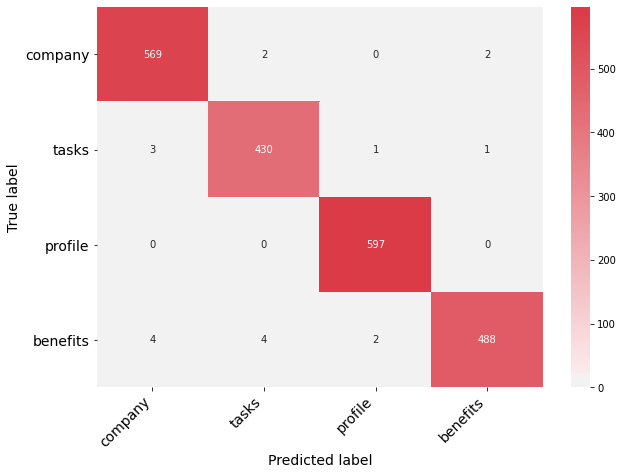
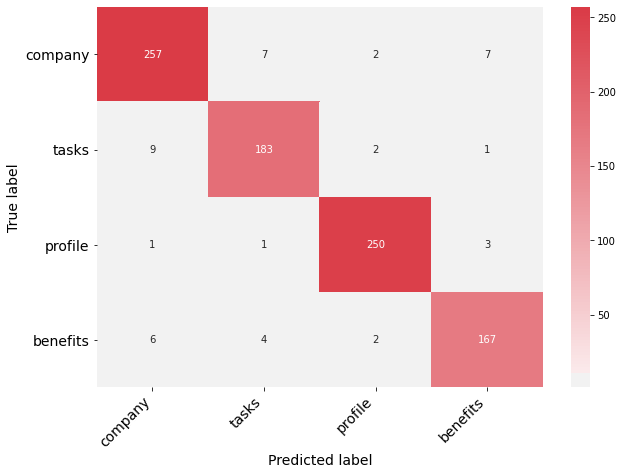
One nice way to measure the model accuracy is confusion matrix. Here is the code the plot the heatmap.
import matplotlib.pyplot as plt
import seaborn as sns
from sklearn.metrics import confusion_matrix

labels = ["company", "tasks", "profile", "benefits"]
y_pred_train = GBC.predict(X_train)
y_pred_test = GBC.predict(X_test)
cm_train = confusion_matrix(y_train, y_pred_train, labels=labels)
cm_test = confusion_matrix(y_test, y_pred_test, labels=labels)

def plot_confusion_matrix(confusion_matrix, class_names, figsize=(10,7), fontsize=14):
    """Prints a confusion matrix as a heatmap.

    Args:
        confusion_matrix (ndarray): The numpy.ndarray object returned from a call to sklearn.metrics.confusion_matrix.
        class_names (list): An ordered list of class names, in the order they index the given confusion matrix.
        figsize (tuple): image size
        fontsize (int): Font size for axes labels.

    Returns:
        matplotlib.figure.Figure
        The resulting confusion matrix figure
    """
    df_cm = pd.DataFrame(
        confusion_matrix, index=class_names, columns=class_names,
    )
    cmap = sns.diverging_palette(240, 10, as_cmap=True)
    fig = plt.figure(figsize=figsize)
    try:
        heatmap = sns.heatmap(df_cm, annot=True, center==0, fmt="d", cmap=cmap)
    except ValueError:
        raise ValueError("Confusion matrix values must be integers.")
    heatmap.yaxis.set_ticklabels(heatmap.yaxis.get_ticklabels(), rotation=0, ha='right', fontsize=fontsize)
    heatmap.xaxis.set_ticklabels(heatmap.xaxis.get_ticklabels(), rotation=45, ha='right', fontsize=fontsize)
    plt.ylabel('True label', fontsize=fontsize)
    plt.xlabel('Predicted label', fontsize=fontsize)
- Confusion matrix for training set
plot_confusion_matrix(confusion_matrix=cm_train, class_names=labels)
- Confusion matrix for testing set
plot_confusion_matrix(confusion_matrix=cm_test, class_names=labels)
We could use other measurements e.g. F-score, AUC curve, I might discuss in the future.